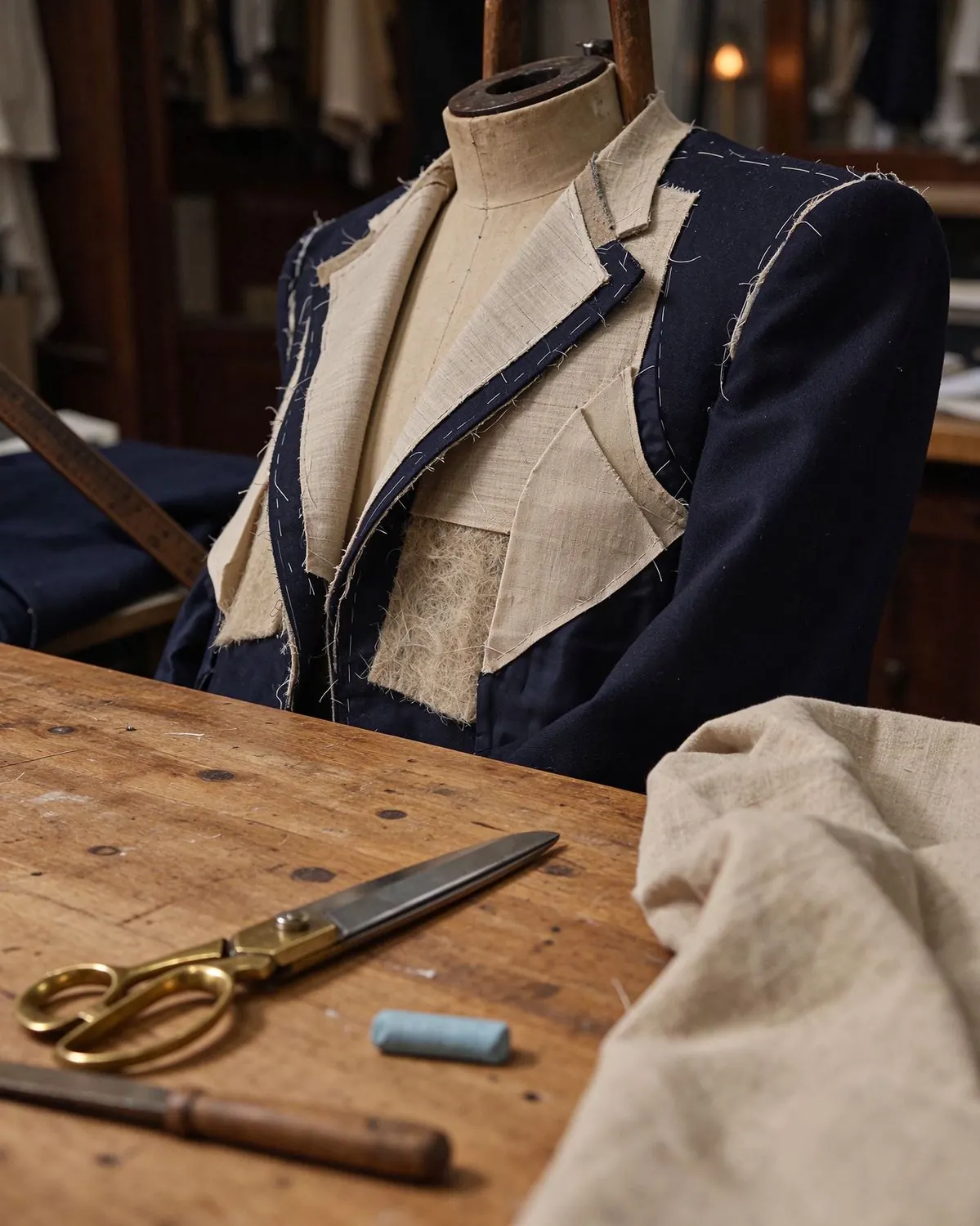
The double-breasted blazer is the one style where button quality decides the sale. Brass that blanks after two cleanings, or a button that sits 3 mm off the stance, is what the customer notices in the fitting room. We cut 6×2 and 4×2 blazers from 100 pieces.
Detail that carries the price
- Buttons: die-cast brass, 24 ligne, 6 front and 4 per cuff; horn and corozo for a quieter read.
- Stance: 6×2 for club and boating, 4×2 for retail; the lower pair sits 7–8 cm below the working button.
- Pockets: patch as standard on unstructured builds, welt with canvas behind on structured ones.
- Cloth: 2.2–2.4 m per blazer at 150 cm; navy hopsack 300–340 g/m² is the volume seller.
| Style | Cloth | Button | Market |
|---|---|---|---|
| Boating blazer | Navy hopsack 320 g/m² | Brass | UK, US, Australia |
| Club blazer | Worsteds, club stripe | Horn or brass | Japan, UK |
| Resort blazer | Cream or stone linen blend | Mother of pearl | Gulf, Italy |
Quoting it
Send the button, the stance and the cloth weight. Button supply is quoted as a trim line so a brass upgrade is visible in the price rather than buried in it. Minimum 100 pieces, 7-day sample, 25–35 days bulk.
- Do brass buttons tarnish?
- Die-cast brass with a lacquer coat holds 20+ cleanings. Stamped brass at half the price usually blanks at ten; we quote both so the choice is explicit.
- Can we use our own buttons?
- Yes. Send them with the sample and we cost the attachment; a shank button needs a different buttonhole than a 4-hole.
- Is a 6×2 harder to grade?
- It needs an overlap check at three sizes rather than one. We do that on the sample, so bulk does not drift at the largest size.
Send the button and stance you want — we quote within one working day. Talk to us →