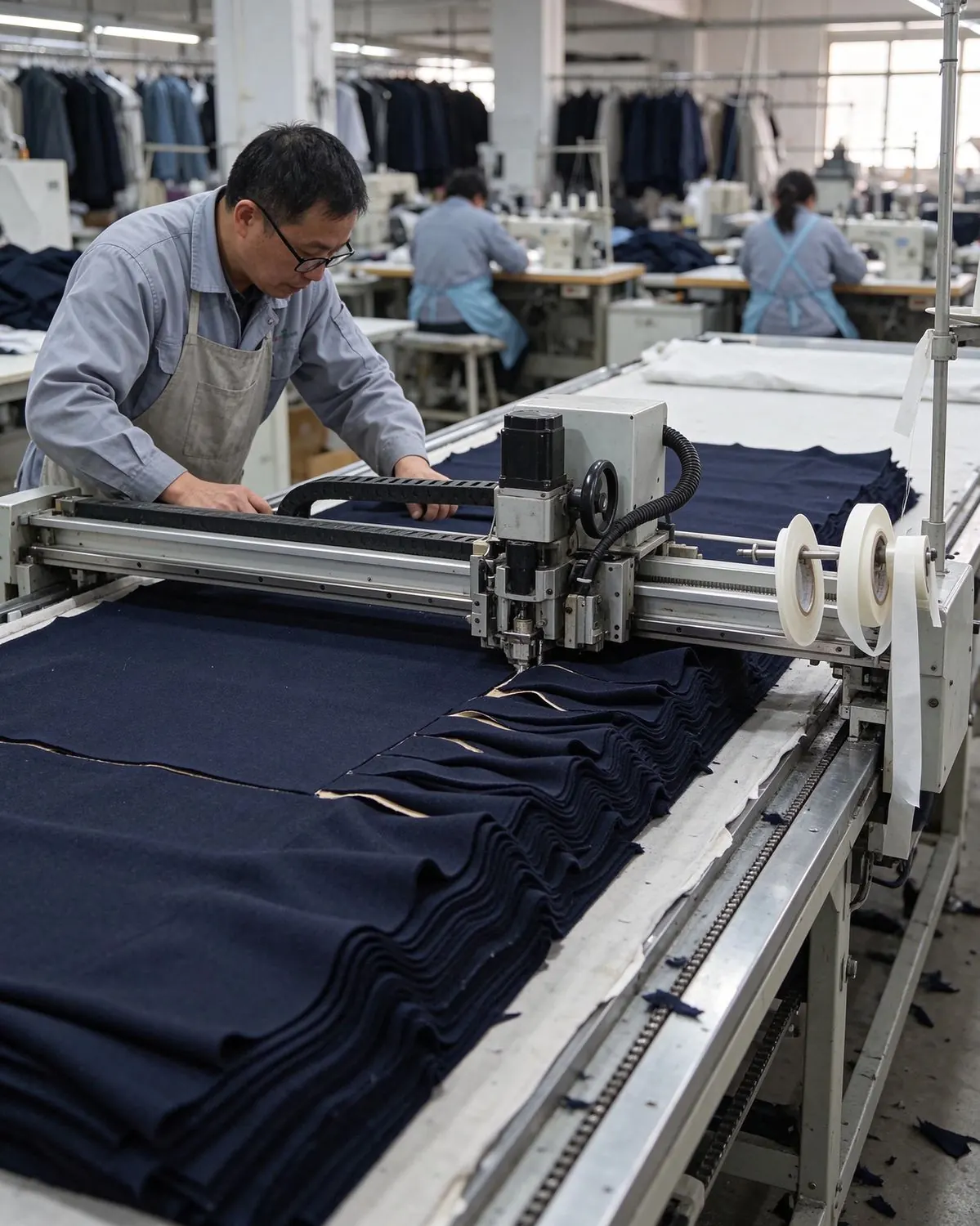
An overcoat is the one garment where weight is the whole argument. At 480–560 g/m2 the coat hangs from the shoulder; at 380 it collapses at the pocket and never recovers.
What decides the piece
- Cloth — 480–560 g/m2 melton, tweed or wool-cashmere.
- Canvas — Canvassed chest and lapel; a fused overcoat ripples at the button within a season.
- Consumption — 3.0–3.3 m at 150 cm for a knee-length single-breasted.
- Lining — Cupro or viscose, full; quilted lining for northern markets.
| Option | Weight | Consumption | Market |
|---|---|---|---|
| Camel | 520 g/m2 | 3.2 m | UK, IT, FR |
| Charcoal | 540 g/m2 | 3.2 m | DE, NL, JP |
| Navy | 520 g/m2 | 3.2 m | US, CA, AU |
Minimums, lead times and tolerances
- MOQ — 100 suits per style, one colourway, mixed sizes in the lot.
- Sample — first sample in 7 days from confirmation.
- Bulk — 25–35 days, depending on cloth arrival.
- Tolerance — ±0.5 cm on all finished measurements.
- Inspection — AQL 2.5, four-point on cloth, ISO 9001:2023, BSCI audited.
Questions buyers ask
- Single or double-breasted?
- Both sell. Double-breasted needs 0.2 m more cloth and a canvassed front.
- Is cashmere worth it?
- A 10–20% cashmere blend softens the hand. Above 30% the coat loses its shape at the elbow.
- How long is the sample?
- Seven days, in the final cloth, with the coat worn open for the drape photo.
Send the coat length and cloth — we quote within one working day. Talk to us →