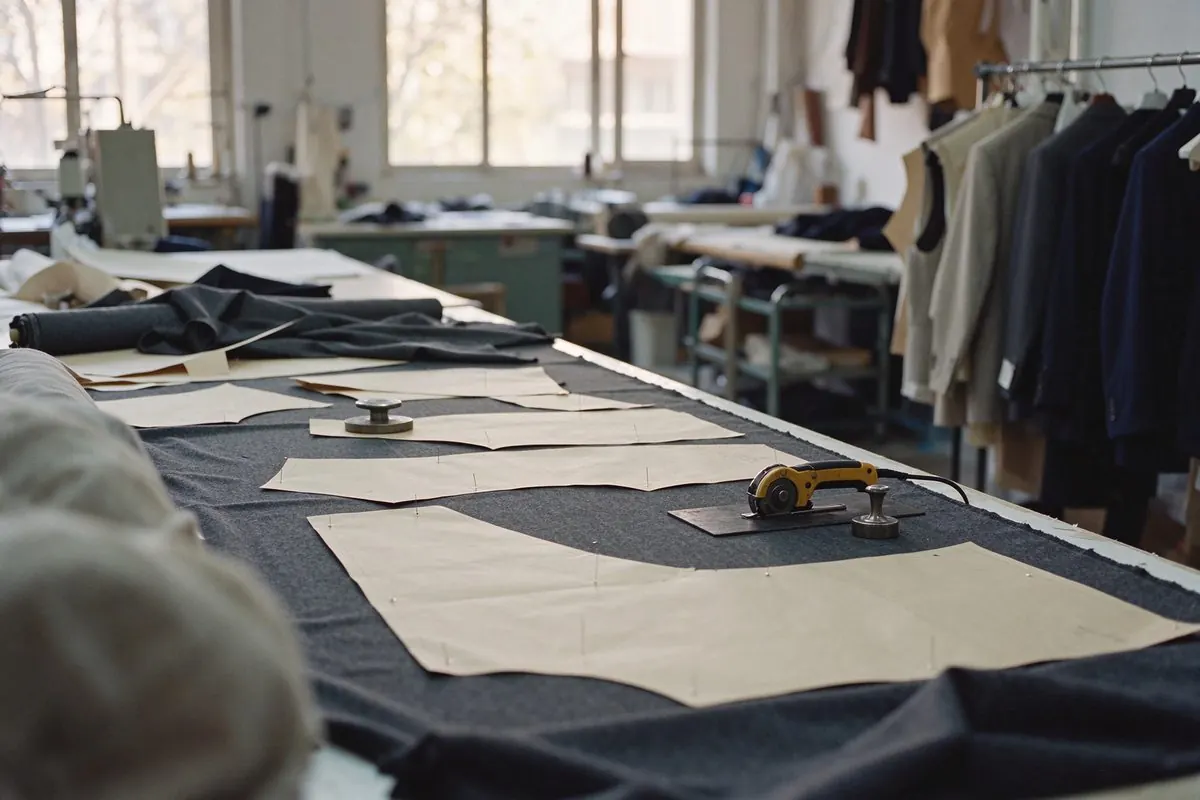
A safari jacket is four pockets and a belt, and the bellows pocket is where the price sits. Every pleat is a separate operation; skipping it turns the jacket into a chore coat.
What decides the piece
- Cloth — 240–280 g/m2 cotton twill or cotton-linen, garment washed.
- Pockets — Bellows with a 3 cm pleat and a boxed flap; flat patch pockets read cheap.
- Belt — Self-fabric, 4 cm, with a covered buckle; leather belts are sourced per order.
- Wash — Garment wash before packing; shrinkage is set before cutting, not after.
| Option | Weight | Consumption | Market |
|---|---|---|---|
| Khaki | 260 g/m2 | 2.4 m | UK, FR, IT |
| Olive | 270 g/m2 | 2.5 m | DE, NL, AU |
| Ecru | 250 g/m2 | 2.4 m | US, CA, JP |
Minimums, lead times and tolerances
- MOQ — 100 suits per style, one colourway, mixed sizes in the lot.
- Sample — first sample in 7 days from confirmation.
- Bulk — 25–35 days, depending on cloth arrival.
- Tolerance — ±0.5 cm on all finished measurements.
- Inspection — AQL 2.5, four-point on cloth, ISO 9001:2023, BSCI audited.
Questions buyers ask
- Is it a summer style only?
- Mostly. In cotton-linen it carries into September in southern Europe.
- Can the pockets be flat?
- Yes, and it becomes a different product. Flat pockets cut 12 minutes per jacket.
- How much wash shrinkage?
- 1.5–2.5% warp. We cut the pattern with that allowance built in.
Send the pocket spec — we quote within one working day. Talk to us →