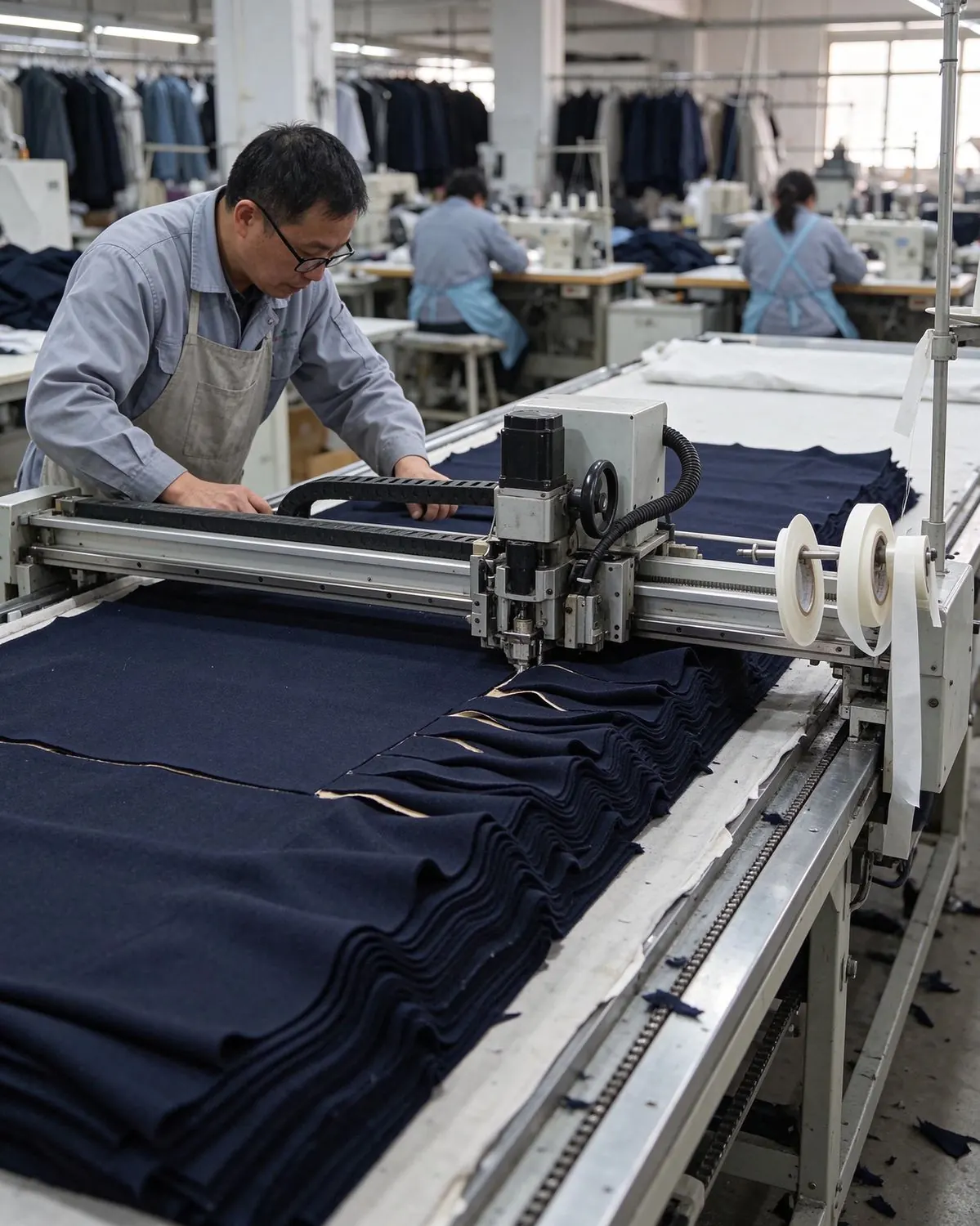
A birdseye is a 2/2 twill with a small diamond figure. At 280–320 g/m2 it hides shine and travel creasing better than any plain cloth, which is why it survives a five-day trade fair.
What decides the piece
- Scale — Small figure, 3–4 mm. A large birdseye reads dated in photographs.
- Weight — 280–320 g/m2 for year-round; 260 for a summer capsule.
- Matching — The diamond must line up across the lapel and the pocket flap, or the jacket looks assembled.
- Trousers — Cut from the same lot and the same direction; the figure shows mismatched panels.
| Option | Weight | Consumption | Market |
|---|---|---|---|
| Navy | 300 g/m2 | 3.4 m | UK, DE, NL |
| Charcoal | 310 g/m2 | 3.4 m | US, CA, AU |
| Mid blue | 290 g/m2 | 3.4 m | AE, JP, SG |
Minimums, lead times and tolerances
- MOQ — 100 suits per style, one colourway, mixed sizes in the lot.
- Sample — first sample in 7 days from confirmation.
- Bulk — 25–35 days, depending on cloth arrival.
- Tolerance — ±0.5 cm on all finished measurements.
- Inspection — AQL 2.5, four-point on cloth, ISO 9001:2023, BSCI audited.
Questions buyers ask
- Is birdseye formal enough?
- For business, yes. For black tie, no — the figure reads in evening light.
- Does the pattern hide stains?
- It hides shine and creasing, not stains. Cleaning is still per garment.
- Can the trousers be sold separately?
- Yes, 100 pieces, same lot, and the figure must run the same direction.
Send the figure scale and the colour — we quote within one working day. Talk to us →