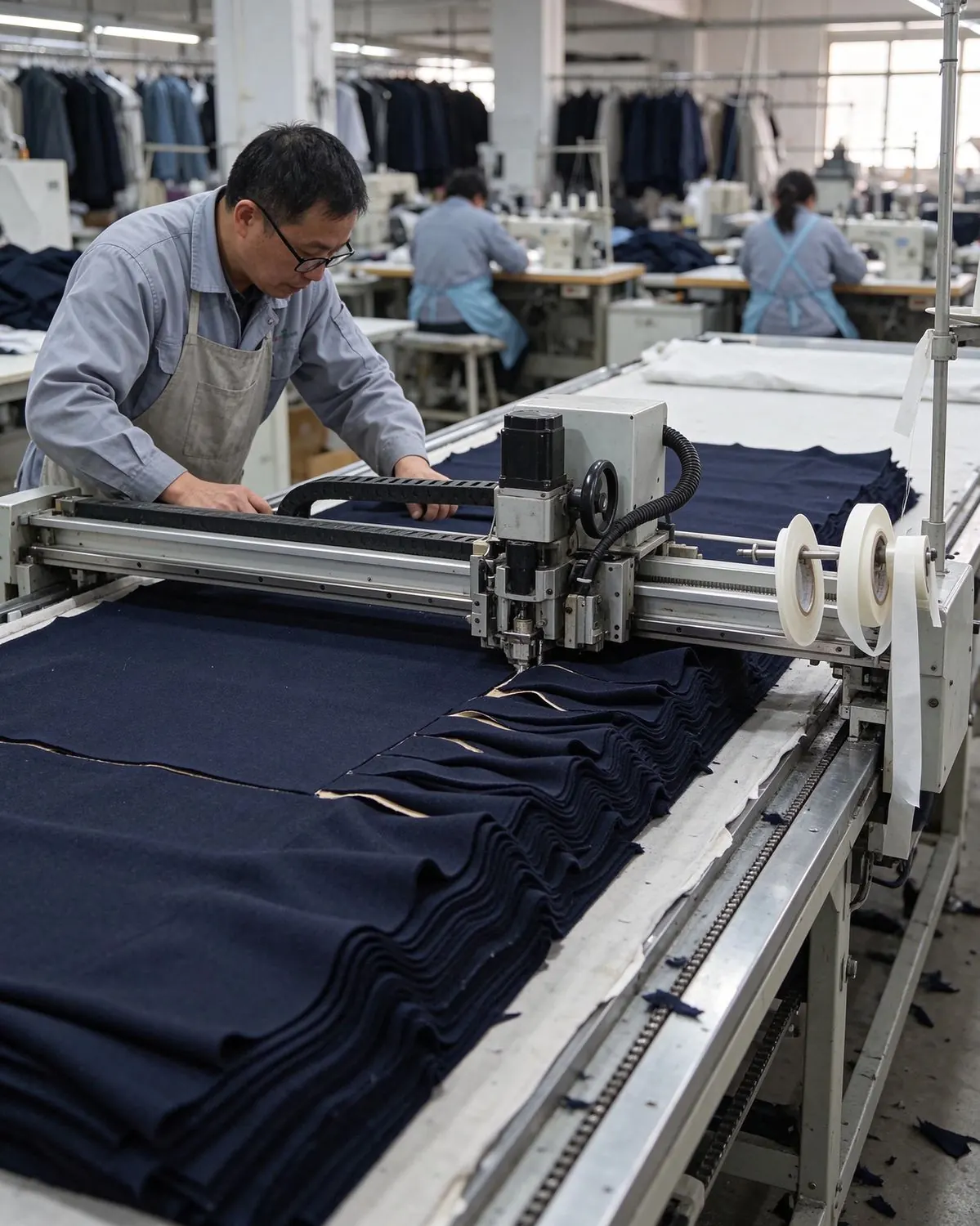
Tweed is the one cloth where the jacket is expected to be heavy, so the mistakes are invisible until the customer wears it. A 420 g/m2 tweed on a fused front stands away from the chest like a board, and an action back cut without allowance tears at the armhole seam by the second season.
Building a tweed coat
- Weight — 380–450 g/m2. Below 350 it stops being tweed; above 470 the shoulder needs a lighter canvas or it will not sit.
- Front — soft half-canvas, floated horsehair. A fused tweed front is the most common import fault.
- Pockets — patch, bellows or flap. Welt pockets on tweed ripple along the opening within a month.
- Action back — 4–6 cm of pleat at the back yoke with a half-lining. Without it the armhole takes the strain.
| Tweed | Weight | Reads as | Market |
|---|---|---|---|
| Harris-style herringbone | 400–450 g/m2 | Country, heritage | UK, DE, JP |
| Donegal | 380–420 g/m2 | Soft fleck, casual | IE, US, NL |
| Shetland check | 390–430 g/m2 | Loud, weekend | UK, IT |
Quoting
100 pieces per style, 7-day sample, 25–35 days bulk. Cloth 2.2–2.5 m per coat at 150 cm; pattern matching on checks adds a day to cutting. ±0.5 cm tolerance, AQL 2.5 final.
- Can tweed be made unlined?
- Only with a bound seam finish and a heavier canvas. Unlined tweed scratches through a shirt within a season.
- Do you match the check at the seam?
- At the side seam and the sleeve head, yes, on a single lot. On a mixed lot the repeat shifts and matching becomes guesswork.
- Is tweed too warm for retail?
- For A/W in northern markets it is the core. For southern markets we cut it in a 380 g/m2 with a half lining and no action back.
Send the tweed and the market — we quote within one working day. Talk to us →