In this note
Every label eventually asks the same question: do we sell ready-to-wear, or do we sell made-to-measure? The answer is rarely about craft. It is about where the cost lands — and a made-to-measure programme at 100 units carries costs that a ready-to-wear programme does not, in places buyers do not look until the first quarter closes.
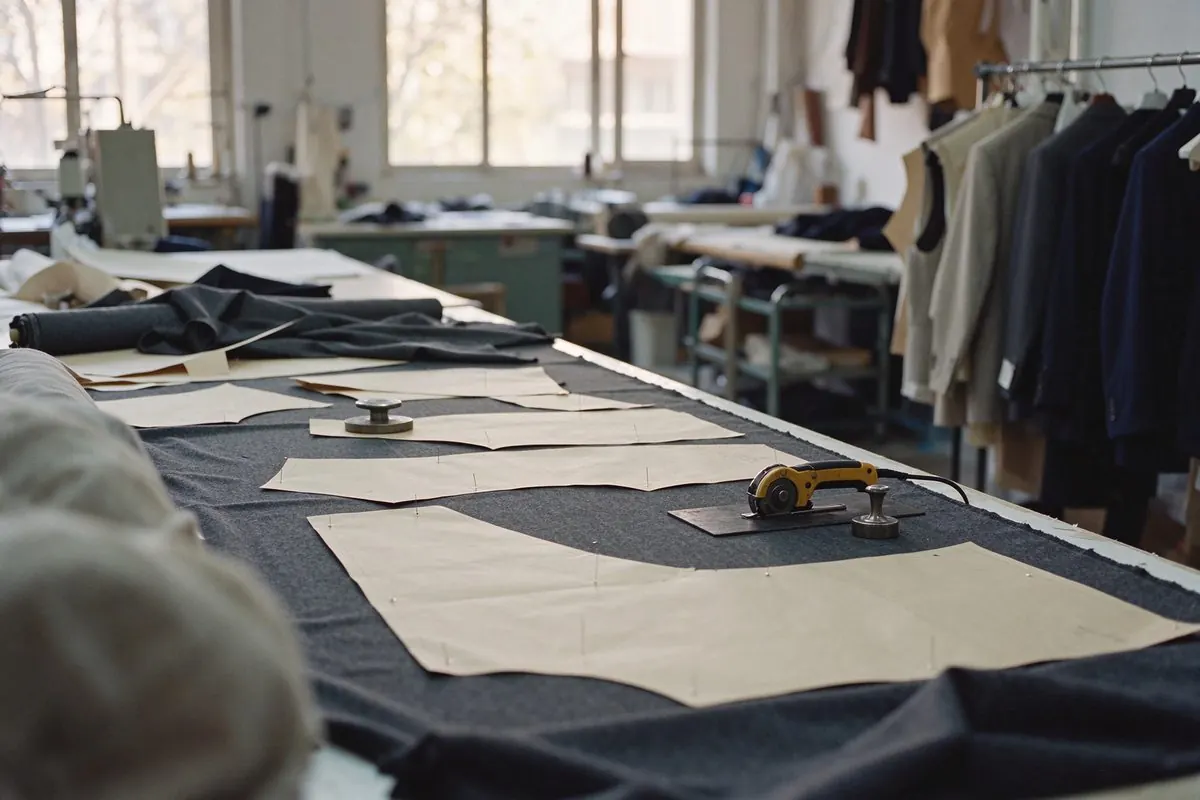
The four cost lines that differ
| Cost line | Ready-to-wear, 100 units | Made-to-measure, 100 units |
|---|---|---|
| Pattern | One block, graded across 6 sizes | One block, then adjusted per order |
| Cutting | Lay of 12–20 plies, marker optimised | Single ply or two, per order |
| Fabric | 100 units in one colourway, one lot | Hundreds of cloth options, small cuts each |
| Selling | Sized stock, no fitting | A fitting, a measurement set, a remake rate |
Pattern and cutting: the multiplier nobody prices
In ready-to-wear, one pattern serves a size run. The marker nests six sizes on a 150 cm lay and the cloth cost per unit is set by that lay. In made-to-measure, every order is its own cut: the pattern is adjusted to a measurement set, the marker runs one or two plies, and the lay efficiency drops by 15 to 25 percent. On a 1.6 m cloth consumption, that is 0.3 m of extra cloth per suit — at 100 units, three hundred metres nobody budgeted for.
Cutting time moves too. A ready-to-wear lay of 18 plies takes one operator about twenty minutes per ply-set; a made-to-measure order takes a pattern adjustment, a check and a single-ply cut. Across 100 units, that is 40 to 60 extra operator hours — visible in the costing sheet as a line called “cutting, single”, which is where MTM programmes usually discover their margin.
Fabric: the minimum problem doubles
Ready-to-wear at 100 units means one cloth, one colourway, one lot. Made-to-measure means a bunch with 40 to 80 qualities, each held in 10 to 30 metre cuts, because the customer chooses. At 100 suits spread across a bunch, you are not buying cloth — you are renting a library. That library is capital, and someone pays for it: either the customer, in the price, or the label, in dead stock.
The workable compromise for a first MTM programme is a curated bunch: 12 to 20 qualities, three to five colourways each, and a promise that anything outside it is a special order with a longer lead time. That keeps the cloth investment inside 600–900 metres and keeps the 25–35 day production window honest.
Fitting and remakes: the cost that arrives late
A ready-to-wear order has one fit session before bulk. A made-to-measure programme has a fitting per customer, and a remake rate of 3 to 8 percent in the first year while the measurement set and the pattern rules settle. At 100 suits, that is three to eight remakes — each one a full garment in cloth, labour and shipping, and each one a customer waiting.
Two things hold the remake rate down: a measurement guide that is photographed step by step, and a tolerance rule that says which adjustments are allowed and which send the order back to the customer before cutting. Without those, the remake rate does not settle, and it becomes the largest line in the P&L after cloth.
The price ladder, at 100 units
| Item | Ready-to-wear | Made-to-measure |
|---|---|---|
| FOB per suit | Baseline | +18 to +30 percent |
| Cloth per suit | 1.6 m | 1.9–2.0 m |
| Cutting labour | Lay-based | +40–60 hours per 100 |
| Sampling | One SMS per style | One base sample plus fitting trials |
| Remakes | Not applicable | 3–8 percent in year one |
Against that, MTM carries a retail premium of 60 to 120 percent in most markets, and a lower inventory risk: no size curve to mark down. The break-even is not a unit count, it is a sell-through assumption. If your ready-to-wear sells 65 percent at full price, MTM at 100 units and a 5 percent remake rate is usually the better business; below 50 percent sell-through, it rarely is.
Where a hybrid works better
The version we see work most often at 100 units is not a pure MTM programme: it is ready-to-wear in a core size block, plus a made-to-measure option on two or three best-selling cloths, sold as an upgrade. The pattern library stays small, the bunch stays curated, the remake exposure stays contained, and the label gets the MTM story without the MTM inventory.
Questions buyers ask
- Is made-to-measure worth it at 100 units?
- Only with a curated bunch and a tight measurement guide. At 100 units, MTM adds roughly 18–30 percent to FOB and a 3–8 percent remake rate in year one; it pays back through a retail premium and lower markdown risk, not through unit economics.
- Can the same pattern be used for both?
- Yes as a base block, but not as a cost. Ready-to-wear grades the block across sizes and cuts in lays; made-to-measure adjusts the block per order and cuts single ply, which is where the extra cloth and the extra hours come from.
- What is the minimum for a made-to-measure programme?
- 100 units per cloth and colourway is workable when the bunch is curated to 12–20 qualities. An open bunch with 60 qualities is a library, and the cloth investment rather than the sewing becomes the constraint.
Send the programme you have in mind — RTW, MTM or the hybrid — and we will cost the three versions against the same 100 units. How an order runs →