In this note
- Page one: the fit block, not the size chart
- Page two: construction, called out piece by piece
- Page three: fabric and trims, with the numbers
- Page four: grading, tolerance and the size run you will actually buy
- Page five: labels, packing and the things buyers forget
- Change control: the page nobody reads until it costs money
- Questions buyers ask
A tech pack is not paperwork, it is the only document the factory reads when nobody from your team is in the building. Most first-order quality problems we see are not sewing failures: they are places where the pack left a decision open, so the pattern room, the cutter and the finisher each filled it in differently. Here is what a suit pack needs to contain if it is going to survive a factory floor.
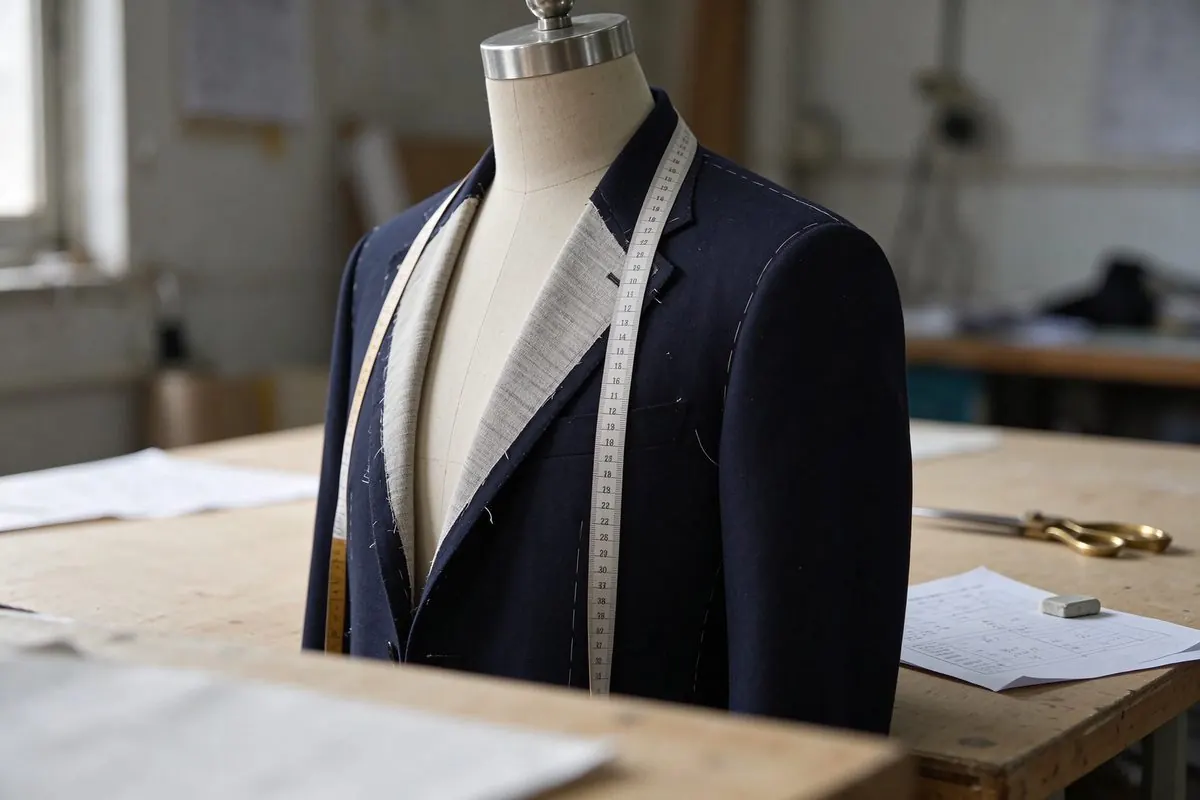
Page one: the fit block, not the size chart
A size chart tells the factory what the customer measures. A fit block tells it what the garment measures, and at which points. For a suit, that means a full points-of-measure sheet on one base size, with tolerances written next to every number.
| Point of measure | Base 50R | Tolerance | How it is taken |
|---|---|---|---|
| Chest, 2.5 cm below armhole | 104 cm | ±0.5 cm | Flat, buttoned, no pull |
| Waist, at the narrowest point | 92 cm | ±0.5 cm | Flat, natural waist marked on the pattern |
| Jacket length, HPS to hem | 76 cm | ±0.5 cm | From high point shoulder, along the front |
| Sleeve length | 64 cm | ±0.5 cm | Shoulder seam to cuff, following the bend |
| Shoulder width | 46 cm | ±0.5 cm | Seam to seam across the back |
| Trouser waist | 82 cm | ±0.5 cm | Flat, waistband closed |
| Front rise | 26 cm | ±0.5 cm | Crotch seam to waistband top |
| Inseam | 81 cm | ±0.5 cm | Crotch to hem, unstretched |
Two things matter more than the numbers: the base size is named, and the measuring method is written. “Chest 104” without “buttoned, no pull” gets measured three ways in three rooms, and every one of them is 104.
Page two: construction, called out piece by piece
This is where a pack earns its keep. Not “half-canvas jacket” — the phrase covers a dozen builds — but the decisions underneath it:
- Canvas and fusing: horsehair chest piece with a floated canvas, or a fused front. If canvas, the weight in grams and whether the lapel is hand-rolled.
- Lapel: width at the widest point, roll line position, notch or peak, and whether the buttonhole is real or mock.
- Sleeve head: wadding or roped, and how much.
- Shoulder: natural, lightly padded, or structured, with the pad thickness.
- Button stance: distance from the top button to the hem, because 2 cm changes the silhouette more than a size does.
- Lining: fibre, weight, and whether the back is a full or half-lining with a yoke.
- Finishes: pick stitching (present, absent, or only on lapel and pocket), AMF on the waistband, taped seams, hem width.
Every one of these is a decision someone in the factory will otherwise make by habit. A callout photo with an arrow beats a paragraph every time; we ask for one photo per construction point on a reference garment.
Page three: fabric and trims, with the numbers
Composition percentage, weight in g/m², weave, shrinkage after the wash test, and the shade band. For trims: button size and material, interlining weight, thread ticket number, zip type and length, and label construction.
| Item | What must be written | Why it fails otherwise |
|---|---|---|
| Shell fabric | Composition, g/m², shrinkage %, shade band | “Wool blend” gets three different cloths across two orders |
| Lining | Fibre, g/m², colour reference | A grey lining reads green against a navy shell |
| Buttons | Diameter in mm, material, finish | “Horn buttons” ranges from 18 to 24 mm |
| Thread | Ticket number, fibre, colour code | Heavy thread on a fine cloth puckers the seam |
| Interlining | Weight, fusible or sew-in, temperature | Wrong fusing temperature shows as a shine on the front |
Page four: grading, tolerance and the size run you will actually buy
Grading rules per point — chest +6 cm per size, waist +6, sleeve +1, length +1.5 — and the size run, stated explicitly. If you are buying S–XL in three colours, write the break-down as a matrix, not as a sentence. A factory that has to derive your size curve will derive it wrong at least once, and that once is usually on the fabric order.
Tolerance is part of the pack, not a negotiation after inspection. We work to ±0.5 cm on garment measures and AQL 2.5 on visual defects; if your standard is tighter, say so on page one, because it changes the inspection time and therefore the price.
Page five: labels, packing and the things buyers forget
- Care and composition labels with the market’s required wording; EU rules alone need fibre content, importer address and care symbols.
- Hangtag and polybag size, placement, and whether the bag needs a suffocation warning.
- Carton dimensions, pieces per carton, size ratio per carton, and the shipping mark format.
- Folding standard with a photo: a jacket folded for a carton is a different fold from one going on a hanger.
Change control: the page nobody reads until it costs money
Version number, date, and a redline of what changed. A pack that is edited by email without a version number produces two factories in one building — one cutting to the March drawing and one to the April one. Our rule: any change after the fit approval is a new version, and the version number goes on the cutting ticket.
Questions buyers ask
- How detailed should a tech pack be for a first suit order?
- Detailed enough that the pattern room, cutter and finisher never have to guess. In practice: a points-of-measure sheet on one base size with tolerances, construction callouts with photos, fabric and trim specs with numbers, grading rules and the size matrix, label and packing instructions, and a version number.
- Can you build a tech pack from a reference garment?
- Yes. Send the reference suit, your size chart and the target FOB. We measure the garment, write the points of measure, photograph the construction points and send the draft pack back for your comments before sampling.
- What happens if the pack changes after sampling?
- It becomes a new version with a redline, and sampling usually restarts at the changed point. That is why we push construction decisions to page two before the first pattern is cut — a change at the pattern stage costs days, the same change after bulk cutting costs the cloth.
Send a reference suit and your size chart — we will draft the pack and mark every open decision before it reaches the pattern room. How we work →