In this note
Every factory quote ends with a minimum: 100 pieces per style. That number is real, and it is also the last minimum in a chain of five. The cloth mill, the dye house, the label maker and the trim supplier each set their own — and when they are bigger than the garment minimum, the garment minimum stops being the constraint that decides your order.
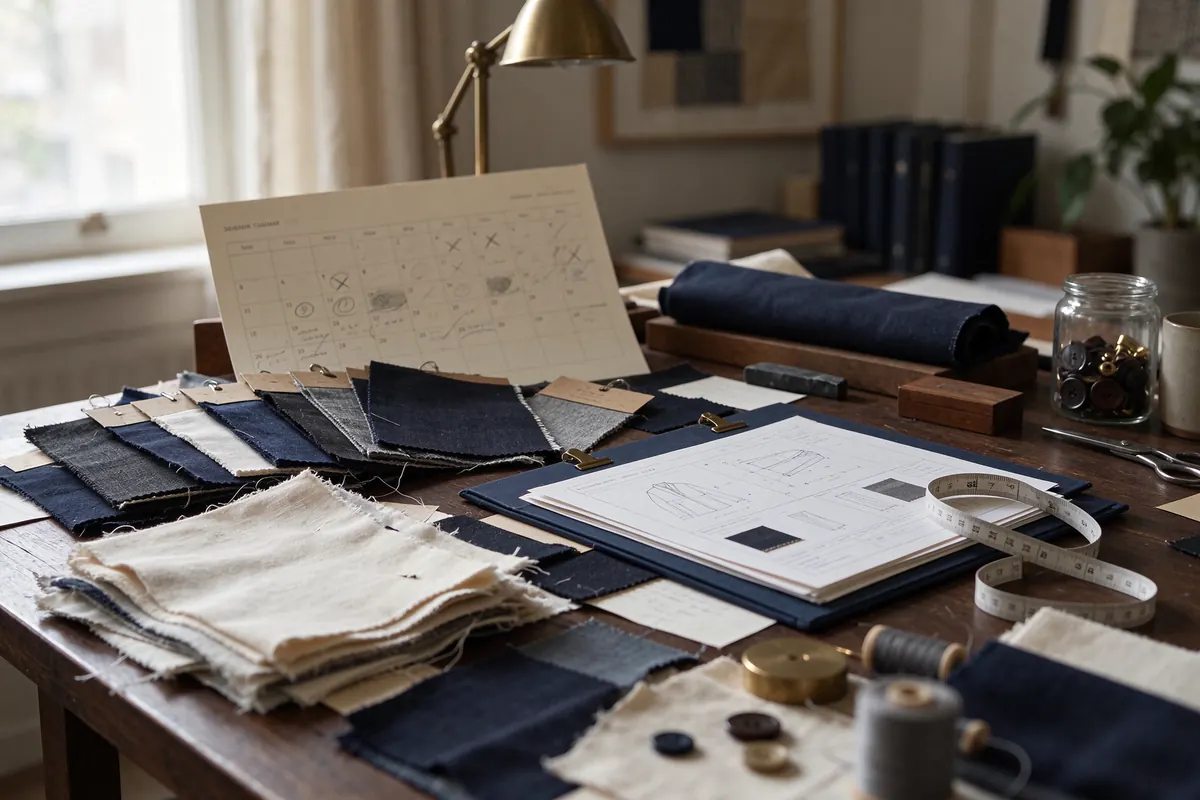
Five minimums behind the minimum
| What you are buying | The real minimum | What 100 suits need | What that leaves on your shelf |
|---|---|---|---|
| Wool cloth, stock bunch | No minimum beyond the order, subject to what is on the roll | 330 m (3.2–3.4 m per suit) | Nothing, if the mill has the length |
| Wool cloth, custom colour or weave | 300–500 m per colour | 83 m per colour at four colours | 217–417 m per colour, so 870–1,670 m in total |
| Lining, stock | Usually 100–300 m, often by the roll | 120 m (1.2 m per jacket) | Nothing to 180 m |
| Lining, dyed to match | 500 m per colour at most mills | 120 m | 380 m, which is three more orders |
| Woven main and care labels | 500–1,000 pieces per label | 100 of each | 400–900 labels per variant |
| Hangtags and polybags | 500 pieces at short-run pricing, 1,000 at the good price | 100 | 400–900 units |
| Buttons | Sold by the gross (144) | 16–20 per suit, so 1,600–2,000 | Nothing — 12–14 gross is a normal buy |
| Sewing thread | Colour-matched cones, 50–100 per dye lot | 10–15 cones | 35–85 cones in one colour |
Buttons and thread are fine at 100. Cloth, lining and labels are where a first order quietly turns into a stock purchase.
The arithmetic of carrying the balance
Take the four-colour case. 100 suits, 25 per colour, 83 metres of cloth per colour. A mill minimum of 300 metres per colour means buying 1,200 metres to use 330. At USD 12 a metre for a mid-weight worsted, that is USD 14,400 spent and USD 10,440 sitting as dead stock — USD 104 per suit before a single seam is sewn.
This is why a factory that quotes 100 on custom cloth either has not costed the cloth, or is about to come back with a supplement. It is also why the same factory can hold 100 on stock cloth without any supplement at all: there is no balance to carry.
The same logic applies to a custom lining at 500 metres: you need 120, you buy 500, and the extra 380 metres will outlive the collection. For labels the money is smaller but the ratio is worse — 100 labels against a 1,000-piece minimum is a tenfold buy, and the next season’s logo change makes them waste.
Where a mill minimum can be bent
- Stock bunch, short length. Ask for the actual remaining length on the roll before you commit to a colour. A mill with 180 metres left will often sell it at stock price rather than hold it.
- Piece-dyed greige. Buy greige cloth from stock and dye it in the garment country. The mill minimum applies to greige, which is cheaper and more available; the dye house minimum, usually 300–500 metres per colour, is the one that remains.
- Two colours, not four. Halving the colour count doubles the metres per colour and can put you over a mill minimum with no extra stock.
- Contrast, not custom. Use a stock cloth for the body and a stock lining that reads as intentional. Buyers notice a badly matched custom lining more than a well-chosen stock one.
- Labels at short-run price. Pay the 30–50 percent short-run premium once, on 100 labels, rather than buy 1,000 you will redesign next season.
What to ask before the deposit
- Is the cloth stock or custom, and how many metres are on the roll? Get the length in writing, not the colour name.
- What is the mill minimum per colour, in metres? Convert it to suits yourself: metres divided by 3.3.
- Who carries the balance? If the answer is “you”, price it into the order.
- Are lining, interlining and labels stock or custom? Each has a separate minimum; ask for all three at once.
- Does the quote assume the same cloth for the repeat? A stock colour can sell out between orders, and the replacement will not match the first run.
How we handle it
Our 100-piece minimum is quoted on stock cloth, stock lining and stock trims, and we say so on the quote. When a design needs a custom colour, we quote the mill minimum openly, show the metres you would carry, and offer the two routes that usually work: a stock colour close enough to sell, or a larger first order that absorbs the cloth. We do not hide a 300-metre cloth minimum inside a 100-piece garment price and hope the invoice is not read.
First sample in seven days from a confirmed spec, bulk in 25–35 days, ±0.5 cm on finished measurements, AQL 2.5 before packing.
Questions buyers ask
- Does a 100-piece suit order need custom cloth?
- No, and it usually should not. Stock cloth carries no mill minimum beyond the length on the roll. Custom colour at 100 suits means buying 300–500 metres per colour and carrying the balance.
- Can I get a custom lining colour at 100 suits?
- Rarely at a sensible price. Most lining mills start at 500 metres per colour; 100 jackets need 120. A stock lining in a close tone is the practical answer.
- Are labels really a 500-piece minimum?
- At normal pricing, often 500–1,000 per variant. Short-run weaving exists at a 30–50 percent premium, which is usually cheaper than 900 labels you will never use.
- What if the stock cloth runs out before my repeat order?
- Ask for the remaining length and reserve it. If the mill cannot hold it, treat the first run as a limited colour and plan the repeat on a different stock cloth.
Send a tech pack, a reference jacket or a photo with a size chart — we quote within one working day. How an order runs, from brief to container →