In this note
“MOQ 100 pieces” sounds like a single number. It is usually two: 100 per style, or 100 per colour — and the gap between those two sentences is where a first order quietly triples. Before you compare factories on price, agree on which sentence is on the table.
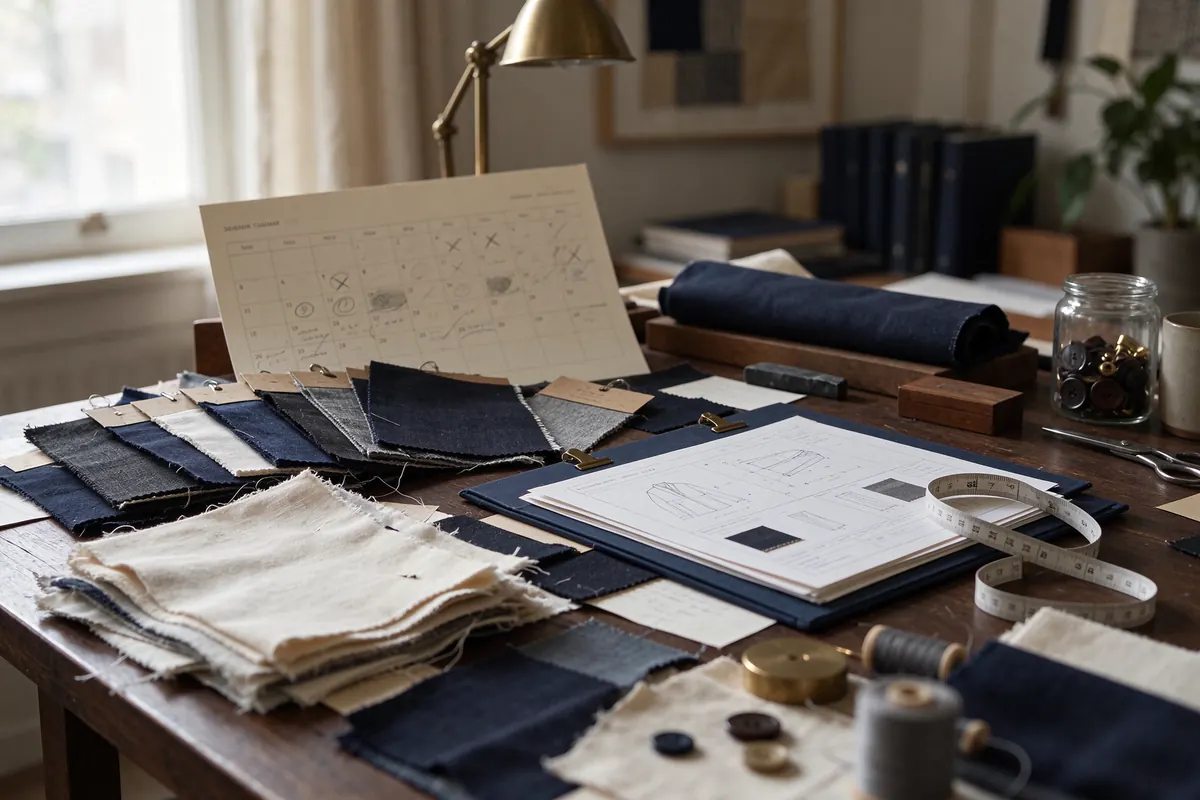
Two sentences that mean different things
| What the quote says | What it actually commits you to | At 4 colours and 5 sizes |
|---|---|---|
| 100 pcs per style | One style; colours and sizes can be mixed to reach 100 | 100 total, 5 per size per colour |
| 100 pcs per colour | Every colour must reach 100 on its own | 400 total, 20 per size |
| 100 pcs per colour and size | Every SKU reaches 100 — rare outside chain retail | 2,000 total |
Factories are not being slippery when they use the first sentence; it is genuinely how a small order is cut. The problem is that buyers hear the first sentence and plan a range as if it were the second, or the other way round. Put the sentence in the purchase order, not just in the email.
What 100 suits looks like on the cutting table
Take the common case: one style, four colours, five sizes, 100 pieces. That is 20 SKUs and five units in each. On paper it is a collection. In the cutting room it is a thin lay: five jackets per size means the marker is laid once per colour and the cloth is spread across sizes, which is efficient for cutting and awkward for everything downstream.
It also means the size curve is fixed before you have sold a single jacket. If size 50 sells out in week three, there is no stock to replenish from — the next run is another minimum. This is the real cost of a small first order: not the unit price, the inflexibility.
The minimums that are not on the MOQ line
A suit takes roughly 3.2 to 3.4 metres of 150 cm cloth: about 2.0 m for the jacket and 1.3 m for the trousers, before wastage. At 100 suits that is 330 metres. Now compare that with the other minimums in the chain:
- Cloth. Stock bunch cloth has no minimum beyond the order. A custom dye or weave usually starts at 300–500 metres per colour. At 330 m for the whole order, four colours on custom cloth is not a 100-piece decision — it is a 400 to 600-piece decision.
- Lining and pocketing. Around 1.2 m of lining per jacket, sold in rolls; a custom lining colour has its own minimum, often 500 m.
- Woven labels. Main labels and care labels are often quoted from 500 or 1,000 pieces. At 100 garments you are buying four to ten times what you need, or paying a short-run surcharge.
- Buttons. Sold by the gross (144). A two-button jacket with four cuff buttons per sleeve and trouser buttons uses 16 to 20 per suit, so 100 suits is 1,600–2,000 buttons — about a dozen gross, which is usually fine.
- Hangtags and polybags. Same story as labels: short-run pricing applies below 500.
None of this is a reason to avoid 100 pieces. It is a reason to choose stock cloth, stock lining and stock trims for the first order, and to spend the custom budget on the cut instead.
Where the unit price actually moves
The table below is an index, not a quote: 100 pieces equals 100. It shows direction, which is what a first-order decision needs.
| Cost line | 100 pcs | 300 pcs | 1,000 pcs |
|---|---|---|---|
| Cutting and sewing efficiency | 100 | 94 | 88 |
| Sampling, spread over the run | 2.5 | 0.8 | 0.3 |
| Cloth (stock versus custom) | 104 | 100 | 96 |
| Unit cost index | 106 | 95 | 86 |
Two things to read from it. First, the saving from 100 to 300 is about 10%, and from 300 to 1,000 another 9% — the curve flattens. Second, most of the 100-piece penalty is not labour, it is sampling and short-run materials. If a factory quotes 100 pieces at the same unit price as 300, either the 300 price is soft or something in the specification is about to change.
A sample round costs us USD 100–180 in cloth and labour for a suit. Two rounds on a 100-piece order is USD 200–360, or USD 2–3.60 per garment before anything is cut. On 1,000 pieces the same two rounds are 20 to 36 cents. That is the arithmetic behind “MOQ affects price”.
Five questions to settle before you sign
- Per style or per colour? Get the sentence in writing, and state the colour count you plan.
- Is the cloth stock or dyed to order? If dyed, ask for the minimum in metres per colour and who carries the balance.
- What are the label, hangtag and polybag minimums? These often decide whether 100 is economic at all.
- Can sizes be mixed freely? Some factories cap a single size at 30% of the order; useful to know before you build a curve.
- What does a repeat order look like? If the second run is 300, the first run’s unit price is not the number that matters.
When 100 is the right call
100 pieces works when the product is one style, the cloth is stock, the colour count is one or two, and the goal is proof rather than profit: a trade show sample set, a first drop for a webshop, a fit test across real customers. In those cases the extra few percent per unit is the cheapest market research you will buy.
It is the wrong call when you need four custom colours, a custom lining and a full size run at once. That is not a 100-piece order with a surcharge; it is a 400-piece order that has been split into four, and it will be priced accordingly — or accepted and then delivered late.
What we do at 100 sets
Our minimum is 100 sets per style, and we cut one colourway per lay so the size curve stays clean. Stock cloth from our own bunch keeps the cloth line at stock price; if your design needs a custom dye, we will say so before you commit and show what the minimum does to the total. First sample in seven days from a confirmed spec, ±0.5 cm on finished garment measurements, AQL 2.5 inspection before packing.
If 100 is the wrong number for your range, we will tell you that too, and what the step to 300 would cost. A factory that only ever agrees with the buyer is not giving you a quote; it is taking an order.
Questions buyers ask
- Is your 100-piece minimum per style or per colour?
- Per style. Colours and sizes can be mixed to reach 100, provided the cloth is stock. Custom-dyed cloth carries the mill’s minimum, usually 300–500 metres per colour.
- Can I order 25 pieces in each of four colours?
- Yes, as one 100-piece order with four colourways — not as four separate 25-piece orders. The difference is in the cutting plan and the trim minimums, not in the sewing line.
- Why is the 100-piece price higher than the 300-piece price?
- Sampling, short-run cloth and trim minimums, and a thinner cutting lay. Labour is maybe a third of the gap.
- Will the price drop on the second order?
- Yes, if the pattern, cloth and trims are unchanged. Repeats skip sampling and usually buy cloth at a better rate.
Send a tech pack, a reference garment or just a photo and a size chart — we quote within one working day. How an order runs, from brief to shipment →